3. One region
Each region holds the same stack in five VPCs. Each VPC is a /22 spread over three Availability Zones.
| VPC | Holds |
|---|---|
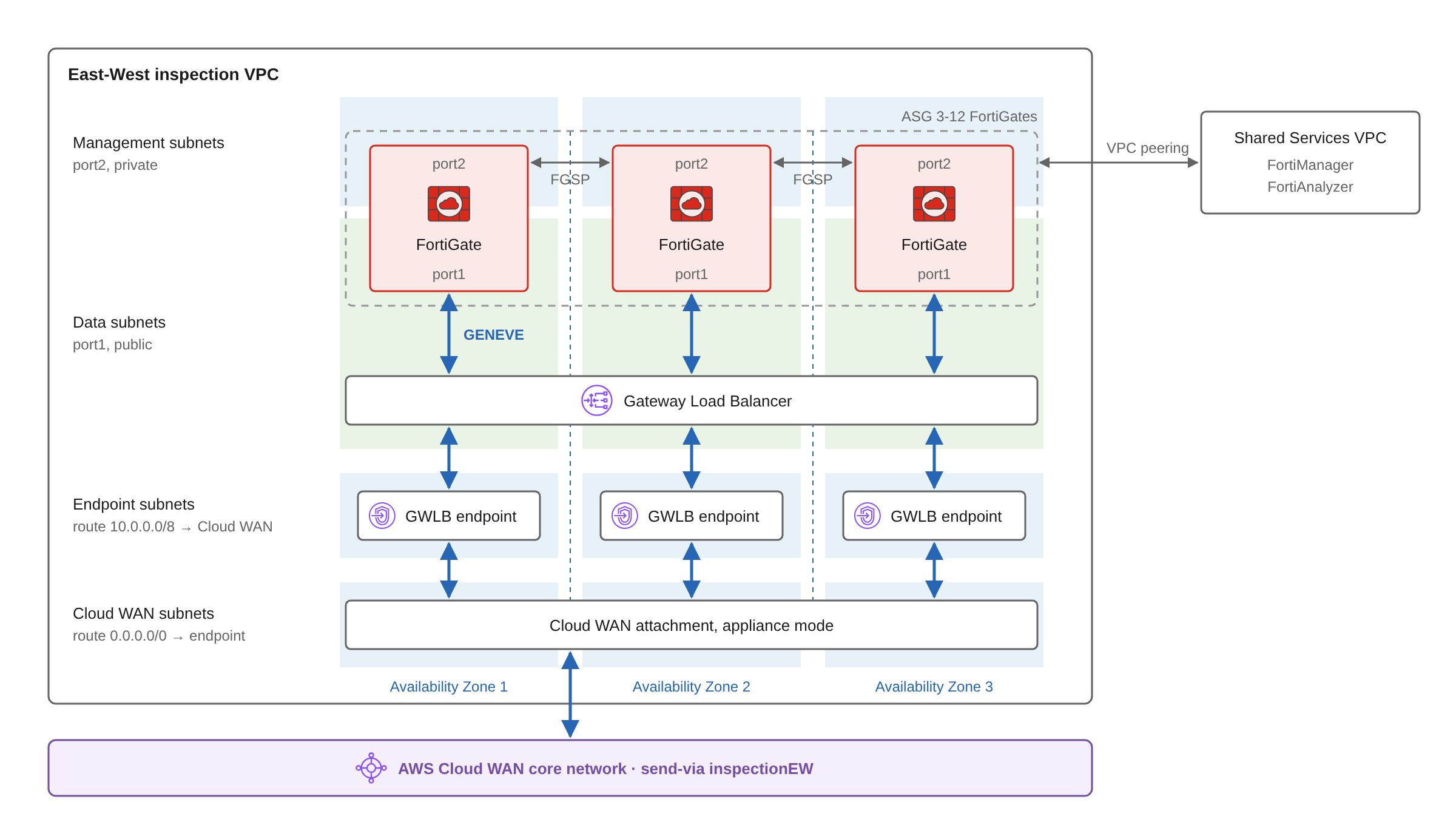
| East-West inspection | Gateway Load Balancer, FortiGate Auto Scaling group, session sync between members, internet gateway for the FortiGates' own traffic |
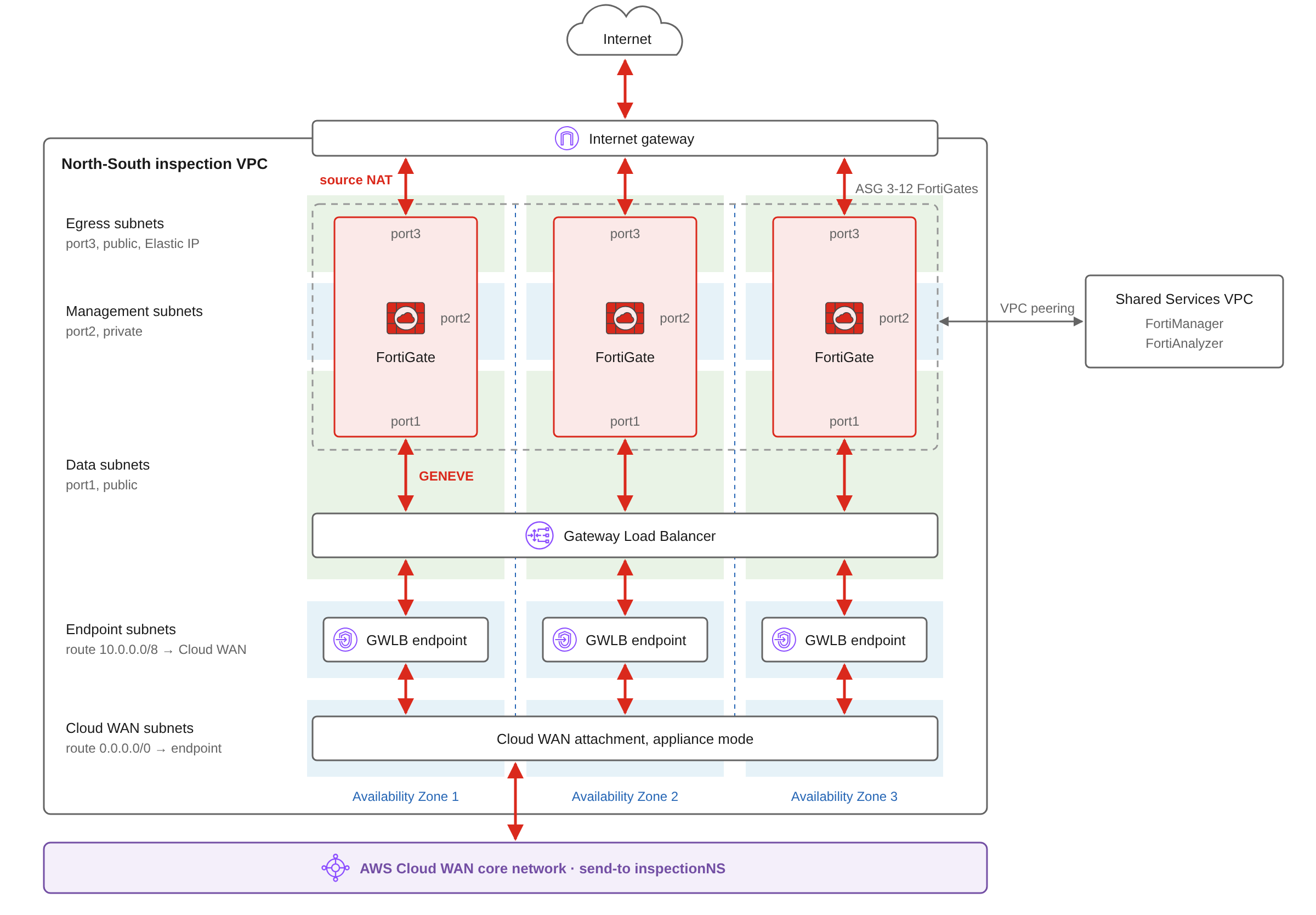
| North-South inspection | Gateway Load Balancer, FortiGate Auto Scaling group, Elastic IP pool, internet gateway for egress |
| Shared Services | FortiManager pair, FortiAnalyzer, canaries (test instances that send traffic through the paths), management bastion, operator jump host, internet gateway for operator access |
| PROD | Workloads. No internet gateway, no NAT gateway |
| QA | Workloads. No internet gateway, no NAT gateway |
Shared Services is also a segment, so its traffic to the other VPCs and to the internet is inspected like theirs. FortiManager and FortiAnalyzer reach the FortiGates over VPC peering, outside the inspected path.
FortiGate interfaces
| Cluster | Interfaces | Use |
|---|---|---|
| North-South | 3 | port1 GENEVE to the Gateway Load Balancer, port2 management, port3 internet egress with an Elastic IP |
| East-West | 2 | port1 GENEVE in both directions, port2 management |
-
North-South is two-arm: one interface takes GENEVE and a separate one sends traffic out. That keeps its policies and routing simpler than one interface carrying everything.
-
East-West returns each packet over the GENEVE interface it arrived on, so it needs no egress interface.
-
Management is its own interface with no default route. It does not depend on the route tables of the traffic interfaces.
-
GENEVE tunnels are logical interfaces on
port1, one for each load balancer node. They add no network interface. -
port1also carries the FortiGate's own traffic, such as licensing and updates, through the VPC's internet gateway. No policy connects a GENEVE interface toport1, so the Elastic IP onport3carries inspected traffic only.
Next: 4. Traffic paths.