5. Failure and scaling
Each cluster is an Auto Scaling group with at least one member per Availability Zone. A Gateway Load Balancer target group has one failover setting, and the two clusters need opposite settings.
-
North-South holds address translation state that no other member has. A failed member needs a TCP reset so the client reconnects.
-
East-West members share their sessions with FGSP, so flows can move to another member.
East-West
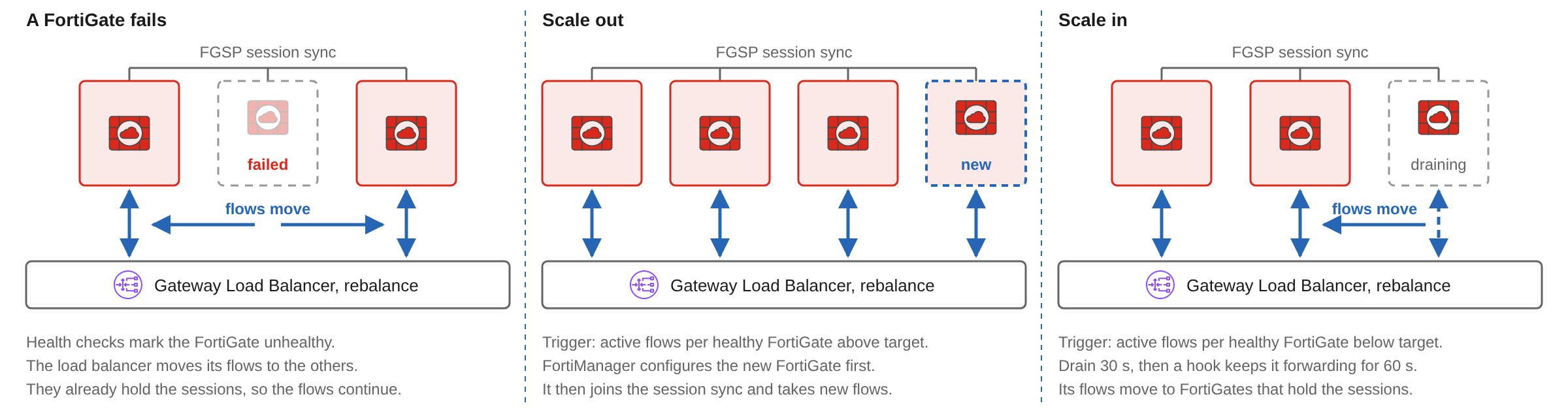
| Event | What happens to a flow |
|---|---|
| A member fails | The load balancer moves its flows to other members. A member that holds the session carries the flow on. The group launches a replacement |
| A member scales in | The load balancer drains it, a terminate hook holds it while flows move, then the group terminates it |
| A member is upgraded | A rolling refresh launches a replacement first and drains an old member only when the new one is healthy |
North-South
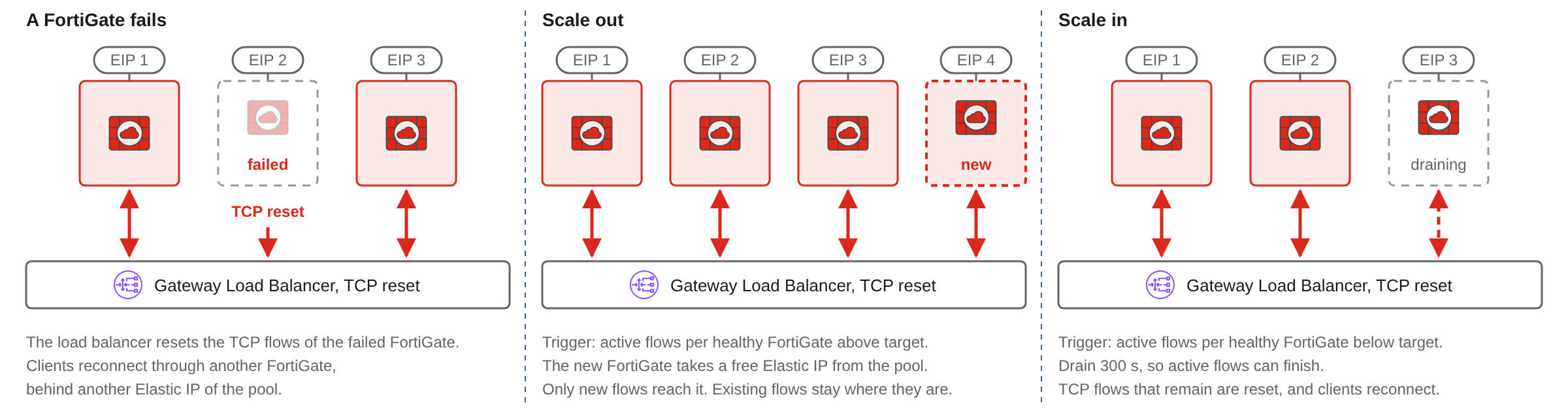
| Event | What happens to a flow |
|---|---|
| A member fails | New flows go to healthy members. Flows on the failed member get a TCP reset and reconnect through another member and another pool address |
| A member scales in | The load balancer drains it so active flows can finish, then resets the rest. Its Elastic IP is freed for the next member |
| A member is upgraded | The same sequence for each member, one replacement launched first |
Never fail open
A member answers the load balancer's health check only after FortiManager has installed its configuration. A member that never configures is replaced. With every target unhealthy, flows are dropped.
What triggers scaling
Each cluster has one target-tracking policy on active flows divided by healthy members. The target is a per-instance-type flow capacity times a percentage, both set in configuration. A cluster never goes below one member per zone.
Next: 6. Management and logging.