4. Traffic paths
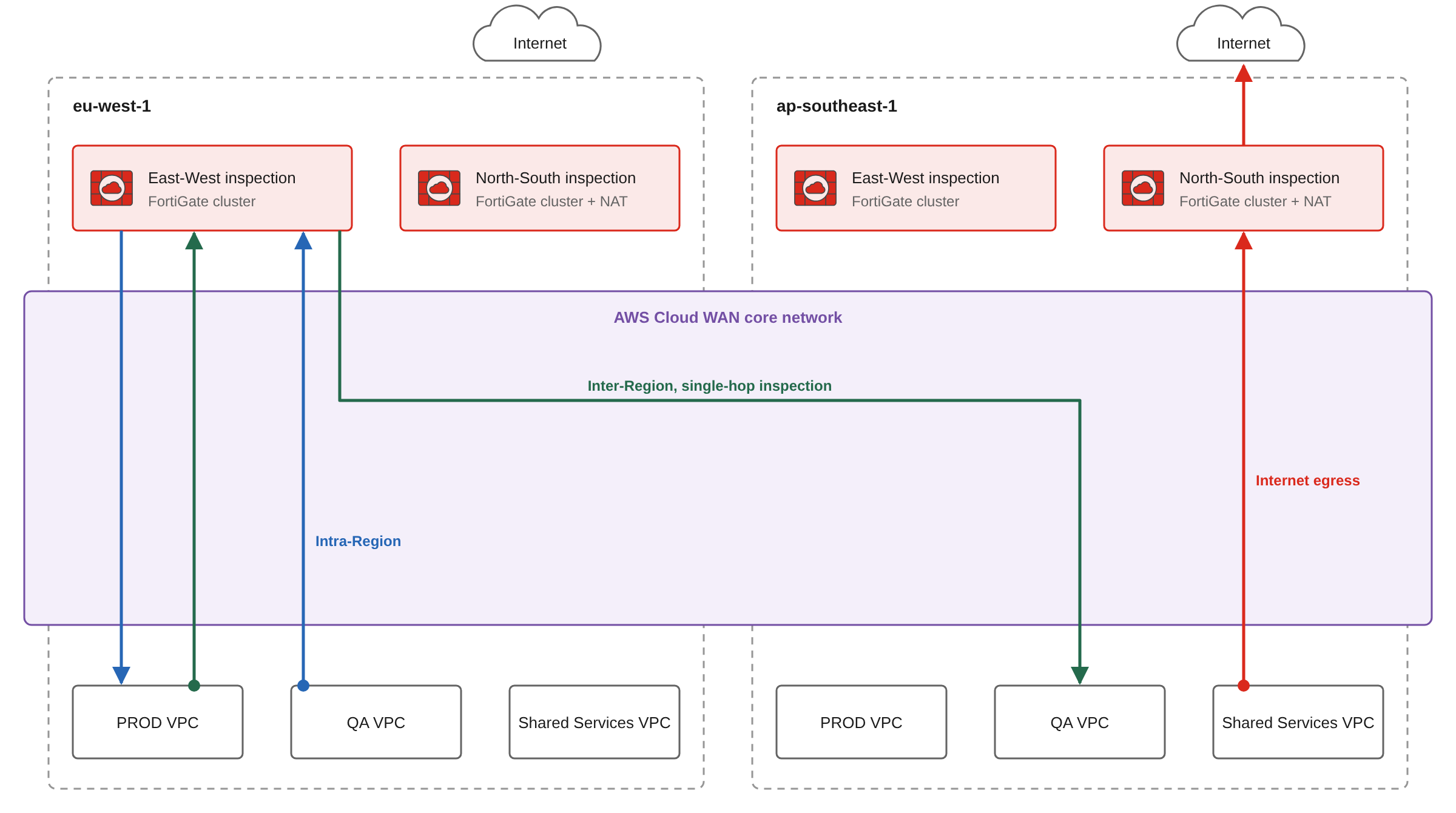
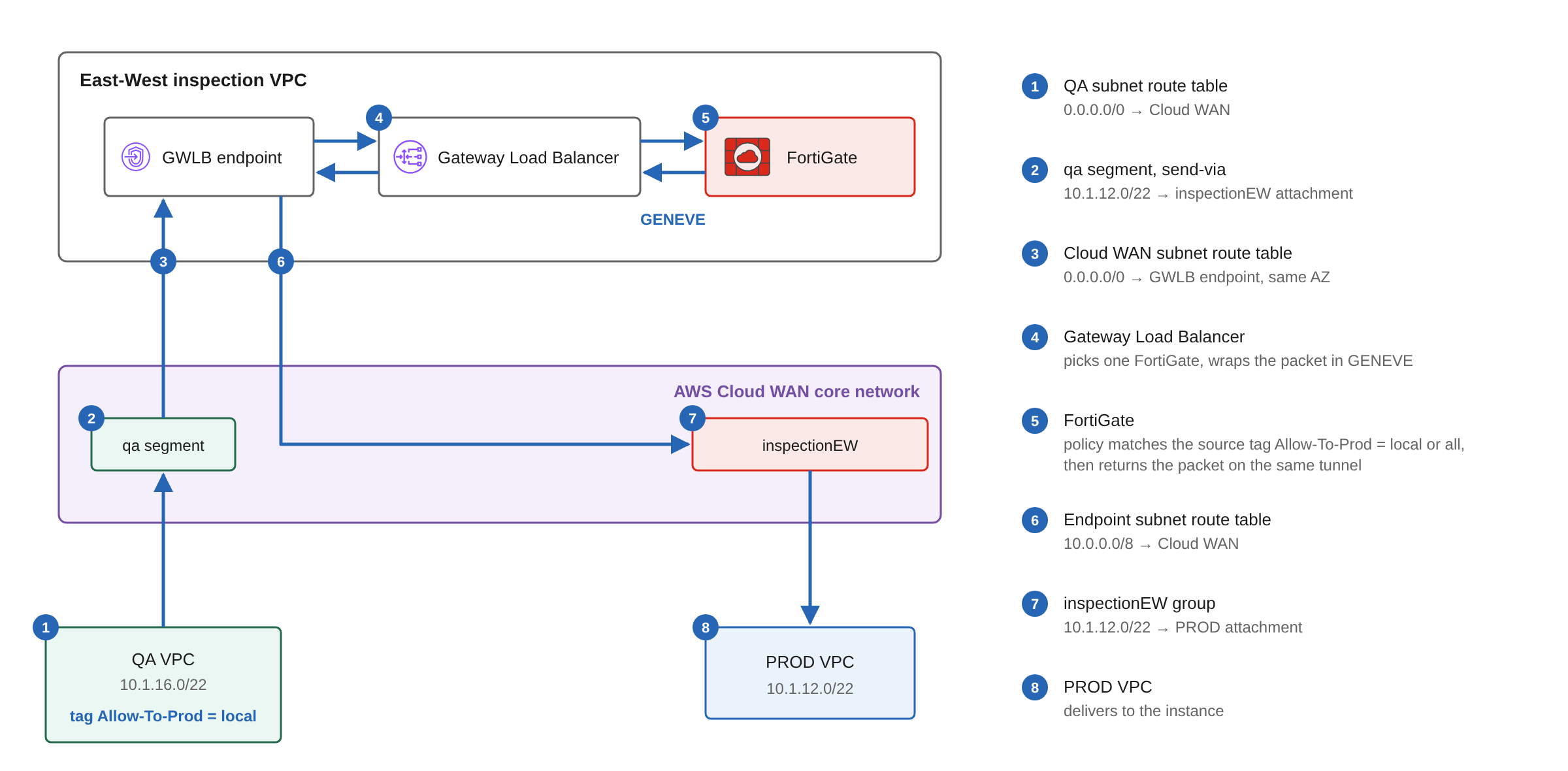
Both clusters are entered the same way. Cloud WAN delivers a flow to the inspection attachment, which has appliance mode on so both directions of a flow stay in one Availability Zone. The zone's route table sends everything to its Gateway Load Balancer endpoint. The load balancer wraps the packet in GENEVE and hands it to a FortiGate.
East-West
PROD -> QA    spoke -> Cloud WAN -> East-West GWLB endpoint -> GWLB -> FortiGate
                    -> GWLB endpoint -> Cloud WAN -> spoke
Cloud WAN matches the segment pair against send-via. The FortiGate checks the policy and returns the packet on the GENEVE interface it came in on. Both directions of a session cross the same member.
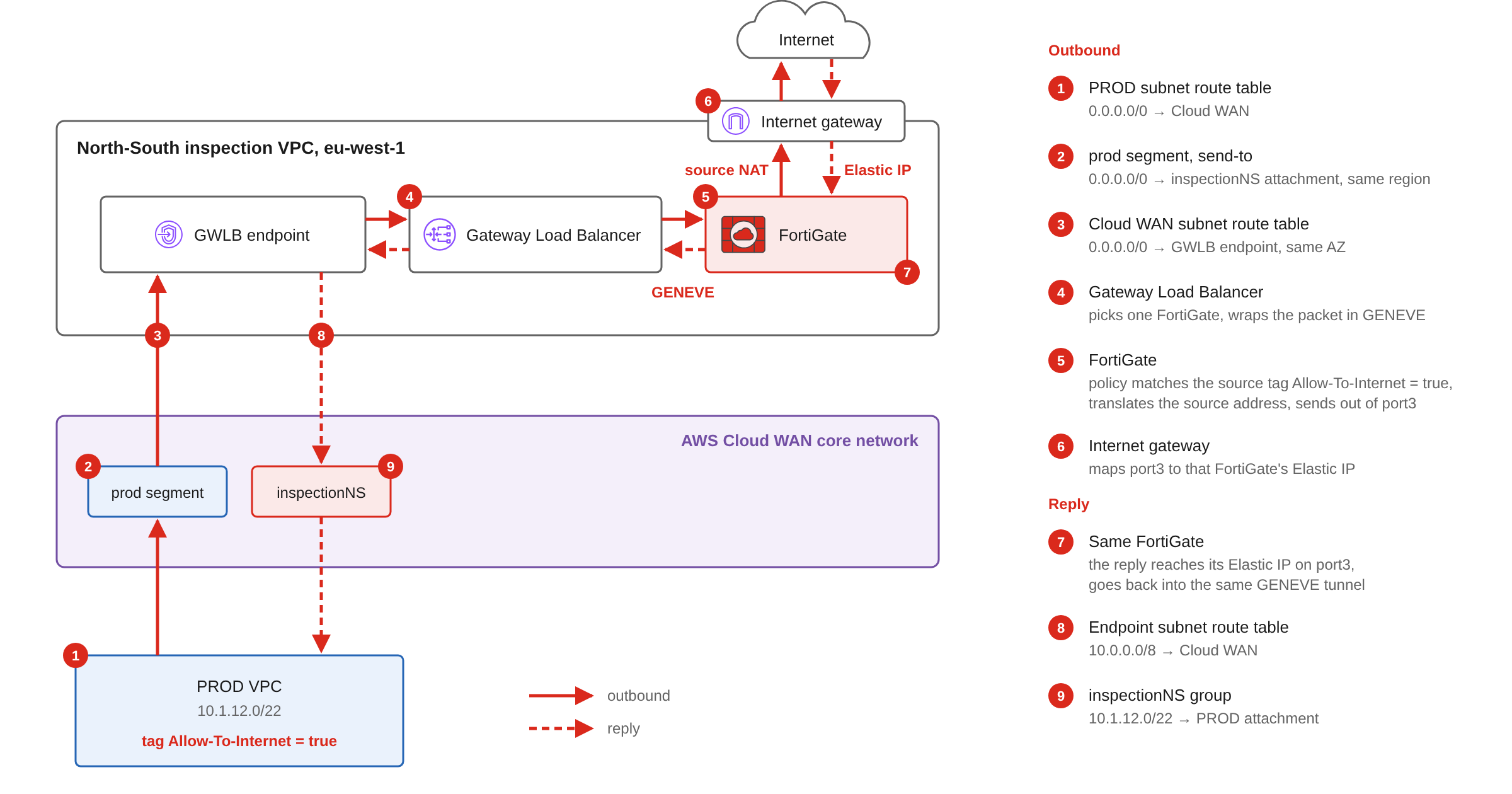
North-South
PROD -> internet   spoke -> Cloud WAN -> North-South GWLB endpoint -> GWLB
                         -> FortiGate (source NAT) -> port3 -> internet gateway
The segment's send-to sends 0.0.0.0/0 to the North-South group. After inspection the
FortiGate translates the source address and sends the packet out port3 behind an Elastic
IP. Only the reply returns over GENEVE.
-
Each member takes a free address from a fixed pool at launch, so the internet sees a stable set of source addresses. The pool is never released with the stack.
-
The reply lands on the member that translated the source, because the address is bound to that member's
port3. -
Each region leaves through its own cluster. There is no NAT gateway.
Between regions
Cloud WAN carries traffic between regions. A flow between regions is inspected once, on one edge, by that edge's East-West cluster, in both directions. In this configuration the eu-west-1 cluster inspects every flow between eu-west-1 and ap-southeast-1.
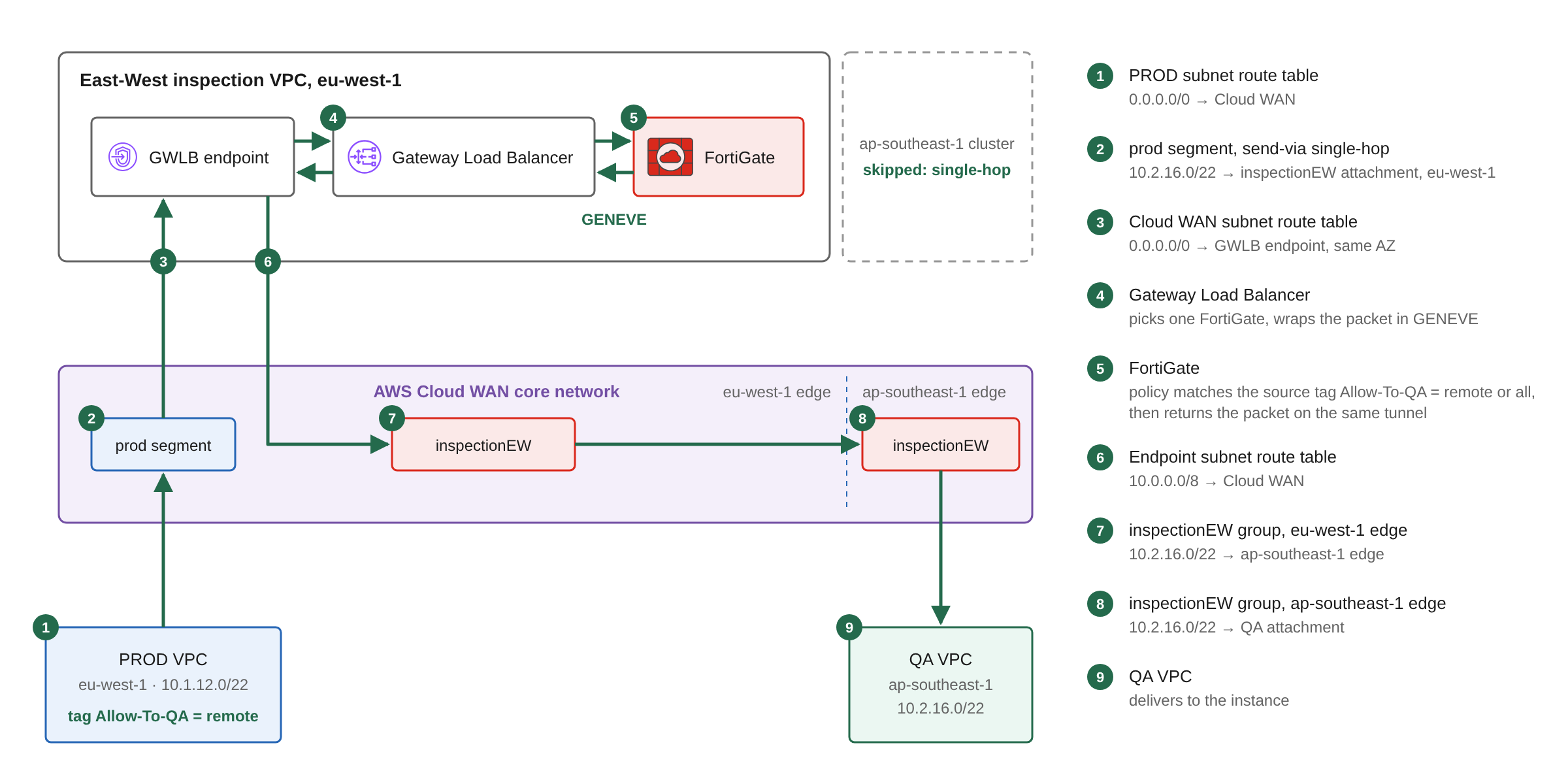
The design uses single-hop: a flow is inspected once and one firewall sees both directions of the session. The chosen edge's cluster carries all inter-region flows of the pair.
Next: 5. Failure and scaling.